
How to Scale Hospital-at-Home Programs Without Adding Logistics Staff
A practical guide to scaling hospital-at-home programs by reducing device burden, centralizing coordination, and using lower-friction RPM workflows instead of adding logistics headcount.
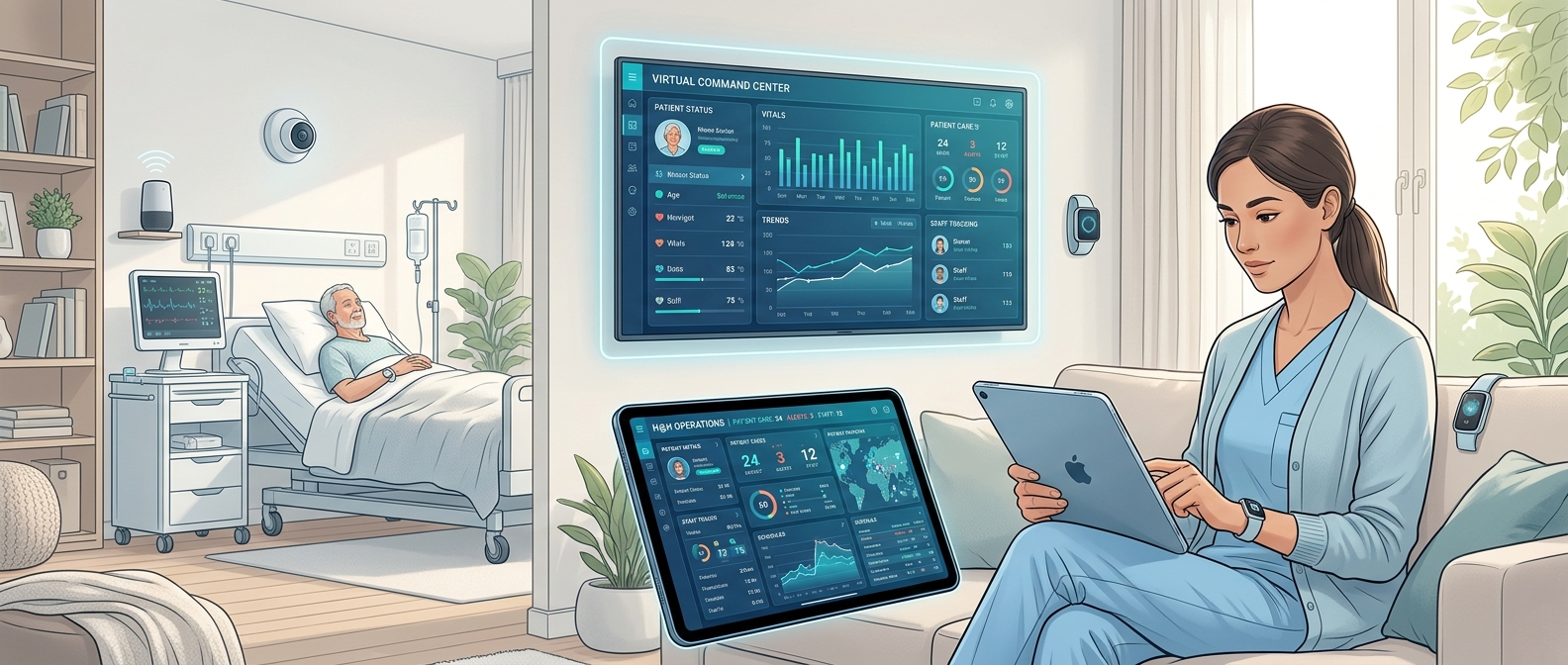
Scale hospital at home without logistics staff sounds like a narrow operations keyword, but it gets at one of the biggest barriers in home-based acute care. Most programs do not stall because clinical leaders doubt the model. They stall because every additional patient creates more delivery, retrieval, setup, replacement, scheduling, and troubleshooting work. If the operating model depends on adding coordinators every time census rises, it does not really scale. That is why many health systems are trying to expand hospital-at-home capacity by simplifying the logistics layer rather than staffing around it.
"For hundreds of years, since the inception of hospitals, we've told patients to go to a hospital to get acute medical care. But in the last 40 years, there's been a global movement to bring care back to the home." — David Michael Levine, MD, MPH, MA, Mass General Brigham
Why scale hospital at home without logistics staff has become an urgent operating question
Hospital-at-home has moved well beyond pilot-stage curiosity. Jay A. Pandit, Jeff B. Pawelek, Bruce Leff, and Eric J. Topol wrote in npj Digital Medicine that the model has grown quickly in the United States, helped by technology advances and the policy environment created during and after COVID-19. CMS data has also helped strengthen the case. Mass General Brigham researchers analyzing 5,858 Acute Hospital Care at Home patients reported a 0.5% mortality rate and a 6.2% escalation rate, with only 2.6% using a skilled nursing facility within 30 days of discharge.
Those outcomes matter, but the operational lesson matters just as much: hospital-at-home programs only stay viable if they can absorb more patients without turning the back office into a delivery company.
Comparison table: scaling by adding logistics staff vs scaling by reducing logistics work
| Scaling choice | Staff-heavy model | Lower-friction model |
|---|---|---|
| Monitoring setup | More device kits, more handoffs, more support calls | Fewer peripherals where clinically appropriate |
| Daily operations | More people coordinating shipments and replacements | More work routed through software, triage, and command-center workflows |
| Failure points | Chargers, pairing, missing kits, return logistics | Mostly patient access, escalation design, and clinical follow-up |
| Cost profile | Headcount grows with census | Better chance to keep staffing flatter as census rises |
| Best use case | Programs that truly require complex device bundles | Programs looking to expand repeatable home-based acute workflows |
What creates logistics drag in hospital-at-home programs
A lot of hospital-at-home leaders start with the wrong assumption. They think logistics problems begin after the patient is enrolled. In reality, they begin with program design.
Logistics burden tends to rise when a program depends on:
- multiple peripherals shipped to most patients
- device pairing and charging support
- urgent replacements when equipment fails or goes missing
- separate teams for onboarding, troubleshooting, and retrieval
- workflows that treat every patient like a high-kit patient
CMS requirements under the Acute Hospital Care at Home waiver reinforce how much coordination is already built into the model. Hospitals have to maintain daily physician or advanced practice provider evaluations and at least two in-person visits each day by nurses or mobile integrated health personnel. When that clinical structure is layered on top of a hardware-heavy RPM design, scaling gets expensive fast.
That is why the real question is not whether logistics matter. Of course they do. The question is which parts of the logistics stack are actually necessary for a given pathway.
How health systems can scale without adding logistics staff
The most practical strategy is not to squeeze more work out of the same people. It is to remove avoidable logistics tasks from the care model.
1. Segment patients by what truly requires hardware
Not every hospital-at-home patient needs the same device package. Some pathways need dedicated peripherals. Others mainly need dependable check-ins, trend visibility, and clear escalation rules.
Pandit, Pawelek, Leff, and Topol emphasized that hospital-at-home expansion depends on the right mix of clinical pathways, technology, and operational support. I think one implication is obvious: if leaders ship a full kit to everyone by default, logistics becomes the bottleneck. If they reserve higher-touch equipment for the patients who genuinely need it, the program becomes easier to scale.
2. Shift from device logistics to command-center coordination
As census rises, the scarce resource is not usually one more courier or one more coordinator. It is centralized visibility.
Programs scale better when command-center or virtual-nursing teams can see who has been admitted, who has completed monitoring, which patients need outreach, and which issues are clinical versus operational. That does not eliminate field work, but it keeps the operating core focused on triage and escalation instead of constant manual chasing.
3. Reduce kit sprawl with camera-based or contactless RPM where appropriate
This is where RPM design starts to affect staffing economics. If some recurring vital-sign checks can be completed through guided camera-based workflows instead of another shipped device, the program removes several common failure points at once:
- no extra hardware to deliver for that task
- no battery or charger issues for that modality
- fewer support calls tied to device setup
- fewer retrieval and refurbishment steps later
That does not mean every hospital-at-home workflow becomes device-free. It means the program becomes more selective about where peripherals add clinical value and where they mainly add operational drag.
4. Standardize escalation instead of customizing every response
Maurer and colleagues' large multicenter RPM study showed that lower-friction remote engagement can translate into better downstream utilization when teams actually own the follow-up process. That same principle matters in hospital-at-home. Scaling depends less on collecting more data and more on knowing who reviews it, what thresholds matter, and what action follows.
When escalation pathways are standardized, staff can manage a larger census without constant reinvention.
5. Design for replacement-resistant workflows
A surprising amount of logistics work is rework. The device is lost. The cuff is not charged. The hub is unplugged. The patient never completed setup. A lower-burden workflow reduces those events before they happen.
For operations leaders, that is the win. The best way to avoid hiring more logistics staff is to stop generating so many logistics tickets.
Industry applications
Health systems expanding acute care at home across multiple hospitals
Multi-site expansion is where logistics complexity compounds. A model that seems manageable in one geography can become chaotic across several service areas. Centralized coordination, pathway standardization, and lighter RPM configurations help keep local teams from rebuilding the same support structure over and over.
Hospital medicine groups trying to preserve command-center ratios
Once a program needs one more logistics coordinator for every incremental census increase, margins disappear. A software-first monitoring layer gives command-center teams a better chance to scale by exception rather than by constant manual intervention.
Care-at-home programs serving older adults with low tolerance for setup burden
Older or medically complex patients are often the least suited to hardware-heavy routines, even though they are the very patients most likely to benefit from care at home. Lower-friction monitoring can reduce the gap between clinical intent and what patients can realistically complete.
Virtual nursing programs tied to post-discharge or step-down pathways
Some programs do not need the full intensity of a traditional home-hospital kit for every day of every episode. In those cases, using a simpler monitoring layer for parts of the pathway can reduce logistics load without reducing oversight.
Current research and evidence
The recent hospital-at-home evidence base is encouraging, but it also points toward an important operational reality.
Pandit, Pawelek, Leff, and Topol describe hospital-at-home as a promising U.S. care model whose broader adoption depends on solving implementation challenges, not just proving clinical value. That framing is useful because logistics is one of those implementation challenges.
The Mass General Brigham national analysis strengthens the clinical case. Across 5,858 patients cared for under the AHCaH waiver, investigators reported 0.5% mortality and 6.2% escalation. Those are the kinds of numbers that make health systems want to grow.
CMS has also reported low unexpected mortality and relatively low transfer rates in the waiver population. But the waiver's structure makes clear that home-based acute care still requires tight coordination, in-person services, and dependable monitoring. In other words, the model is clinically promising precisely when operational control is strong.
That is why lower-friction RPM matters. If a hospital-at-home program can collect clinically useful signals without adding avoidable device logistics, it has a better chance of scaling its care model without scaling its support burden at the same rate.
What hospital-at-home leaders should optimize first
If I were looking at this as an operator, I would focus on five questions:
- Which patients actually need a full shipped device bundle?
- Which monitoring tasks can move to a lighter-touch workflow?
- Where is staff time being spent on troubleshooting instead of triage?
- Can command-center teams distinguish clinical exceptions from logistics exceptions in real time?
- Does every added patient create more coordination work, or just more clinically relevant review?
The programs that answer those questions honestly are usually the ones that scale more safely.
The future of hospital-at-home scale is probably less about more runners and more about less friction
Hospital-at-home will always involve logistics. There is no serious version of this model that removes in-home care delivery, medication coordination, or field services altogether. But that does not mean every part of the workflow should be hardware-heavy.
The better path is selective complexity. Keep the high-touch components where they are clinically necessary. Simplify everything else. Use centralized coordination. Standardize escalation. Reduce unnecessary peripherals. Let nurses and command-center teams spend more of their time on patient status and less on supply-chain cleanup.
That is how health systems scale hospital-at-home without just hiring their way around process friction.
Frequently asked questions
Can hospital-at-home scale without more logistics staff?
Yes, but usually only if the program removes avoidable logistics work. That means segmenting patients, simplifying monitoring, centralizing coordination, and reserving complex hardware for pathways that truly need it.
What is the biggest logistics bottleneck in hospital-at-home?
Often it is not one single step. It is the cumulative burden of device delivery, setup, troubleshooting, replacement, and retrieval layered on top of an already complex care model.
Does camera-based RPM replace all hospital-at-home devices?
No. Some patients and pathways still need dedicated devices. Camera-based or contactless RPM is most useful where it can reduce hardware burden for recurring check-ins without compromising clinical oversight.
Why do command-center workflows matter for scaling?
Because centralized visibility helps teams distinguish which issues need clinical escalation and which are operational. That keeps staffing focused on coordination and response instead of fragmented manual follow-up.
For health systems trying to scale home-based acute care with less operational drag, solutions like Circadify support the broader shift toward software-first monitoring that reduces unnecessary device burden. For related reading, see What Is Passive Patient Monitoring? No-Touch RPM Explained for Clinicians and How to Reduce RPM Device Attrition Rates With Camera-Based Monitoring.