How to Reduce RPM Device Attrition Rates With Camera-Based Monitoring
Research-based analysis of how health systems reduce RPM device attrition with camera-based monitoring, simpler onboarding, and lower hardware burden.
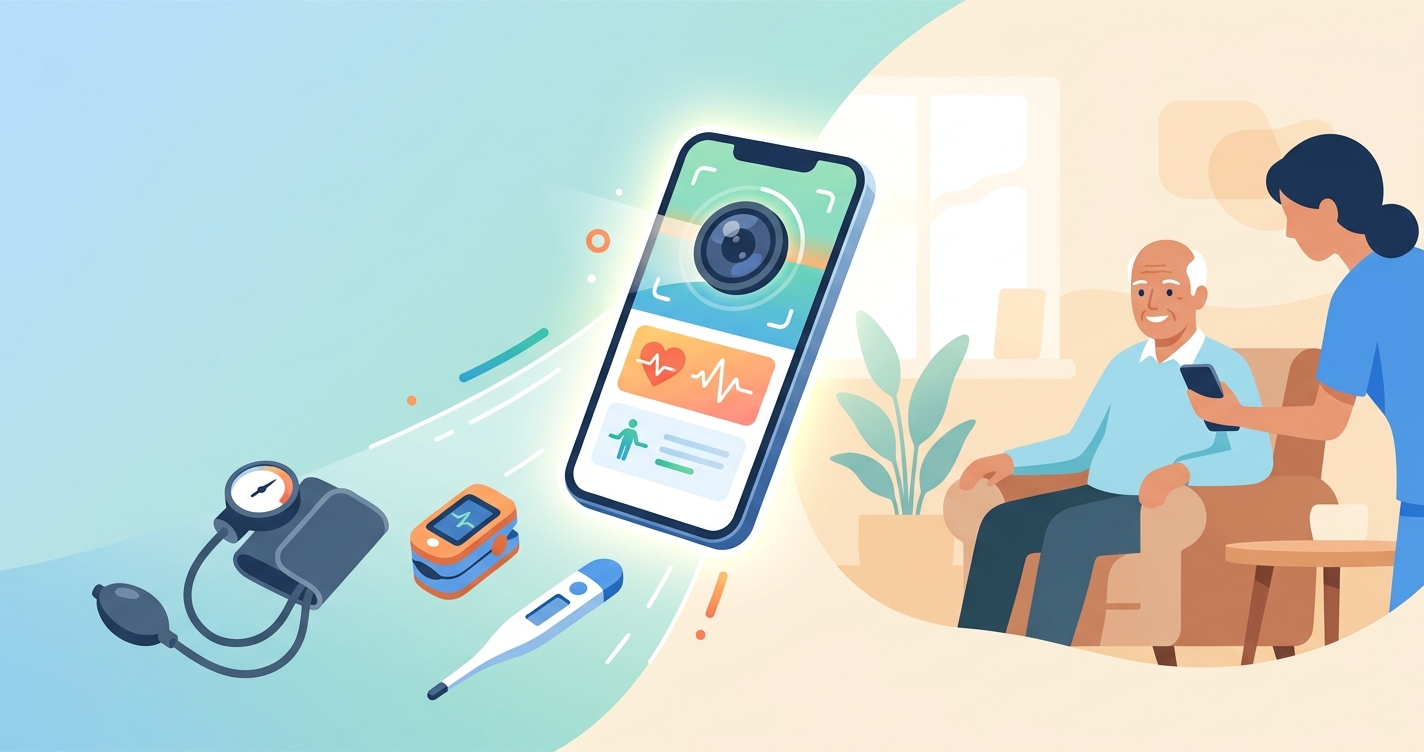
Reduce rpm device attrition camera monitoring is an awkward keyword, but it points to a real operating problem. Remote patient monitoring programs do not usually fail because clinicians dislike the concept. They fail because too many patients stop using the kit, forget the routine, lose a charger, skip a reading, or decide the workflow is one more thing to manage while already feeling unwell. Device attrition is partly a clinical issue, but it is also a design issue. Health systems are paying more attention to camera-based monitoring because it may lower the amount of hardware a patient has to live with, and that changes the odds that an RPM program actually stays in use.
"Contactless camera-based health monitoring can provide lower financial costs, reduced visit times, increased comfort, and enhanced safety for healthcare professionals." — Dimitrios Kolosov, Vasileios Kelefouras, Panagiotis Kourtessis, and Alexandros Mporas, Sensors (2023)
Why reduce rpm device attrition camera monitoring has become an operational priority
Most RPM conversations start with reimbursement, readmissions, or hospital-at-home expansion. Fair enough. But none of that matters much if patients quietly stop participating two weeks in.
That is why attrition deserves more attention than it gets. Device-heavy RPM programs often depend on shipping, setup, pairing, charging, reminders, replacement, and return logistics. Every added task creates another place where the patient can fall off. Katharine Lawrence, Nina Singh, Zoe Jonassen, Lisa L. Groom, Veronica Alfaro Arias, Soumik Mandal, Antoinette Schoenthaler, Devin Mann, Oded Nov, and Graham Dove made a similar point in their JMIR Human Factors case study on RPM implementation: workflow design, staffing, and patient experience determine whether monitoring becomes clinically useful or just another inbox and another burden.
I keep coming back to a simple rule here. Attrition is rarely just about motivation. It is often about friction.
Comparison table: device-heavy RPM vs camera-based RPM for attrition risk
| Program factor | Device-heavy RPM model | Camera-based RPM model |
|---|---|---|
| Enrollment burden | Device assignment, shipping, setup, pairing | App access and camera eligibility screening |
| Daily patient task | Use one or more peripherals correctly | Complete a short guided phone session |
| Logistics failure points | Batteries, chargers, Bluetooth, lost devices, returns | Mostly software access and phone readiness |
| Staff workload | Device support plus clinical review | More of the workload stays in triage and follow-up |
| Likely source of dropout | Hardware fatigue and routine complexity | Engagement still matters, but fewer physical obstacles |
| Best fit | Programs that truly need dedicated peripherals | Programs prioritizing lower-friction repeat check-ins |
What drives RPM device attrition in the first place
Health systems usually describe attrition as a patient-compliance problem. That is too narrow.
Attrition tends to rise when programs have several of these characteristics:
- too many steps during onboarding
- unclear reasons for why the patient is being monitored
- daily tasks that feel repetitive but not meaningful
- hardware that must be charged, paired, and positioned correctly
- weak follow-up when a patient misses readings
- workflows that fit the health system better than the household
That last point matters. Ameen and colleagues, writing about RPM implementation in rural and regional settings, described barriers that sound familiar across many programs: digital literacy gaps, infrastructure limits, training issues, and workflow ambiguity. Those are not minor details. They are exactly the conditions that push device attrition up.
Pereira, Teixeira, Lopes, and Sousa reported a 97% adherence rate over three months in the pilot phase of SmartBEAT for heart failure telemonitoring. That figure stands out partly because good adherence is possible, but also because it usually depends on careful program design rather than assuming patients will tolerate a clunky process forever.
How health systems are reducing attrition with camera-based monitoring
The phrase "camera-based monitoring" can sound like a technology swap. In practice, it is more of a workflow simplifier.
When a patient can complete a monitoring session using a smartphone camera rather than a stack of peripherals, several attrition drivers soften at once:
- there is less hardware to ship and recover
- there are fewer setup steps to teach
- the patient is more likely to use a familiar device
- support teams spend less time troubleshooting accessories
- missed readings are more likely to be an engagement problem than a supply problem
That distinction is useful. Engagement problems can often be addressed with better timing, nurse follow-up, clearer expectations, and tighter pathway design. Supply problems are harder. Once the process depends on boxes, cords, replacements, and device returns, the RPM program starts behaving like a distribution operation.
Dimitrios Kolosov and colleagues did not study attrition directly, but their 2023 Sensors paper on contactless camera-based heart rate and respiratory rate monitoring helps explain the operational interest. They described advantages such as lower cost, reduced visit times, and improved comfort. Those are not just technology benefits. They are adherence benefits in disguise.
Industry applications
Post-discharge monitoring where patients are already fatigued
Patients leaving the hospital are not in the mood for a long setup sequence. They are managing medications, symptoms, family logistics, and follow-up appointments. A camera-based RPM workflow can reduce the burden at exactly the point where attrition usually begins. The patient opens the phone, completes a short check-in, and moves on.
That is one reason software-first pathways are getting more attention for post-discharge surveillance. The goal is not to turn every patient into a home technician. The goal is to make follow-up light enough that it actually happens.
Hospital-at-home programs that need repeat vitals without more kit sprawl
David Whitehead and Jared Conley argued in the Journal of Medical Internet Research that RPM can expand hospital-at-home eligibility, improve safety, and reduce costs when it supports more frequent monitoring. Their point matters here because hospital-at-home can become device-heavy very quickly. If camera-based monitoring can cover some recurring check-ins without adding more equipment, programs may have a better chance of keeping patients engaged over the full episode.
Virtual nursing and centralized triage models
Lawrence and colleagues showed that clinicians care less about novelty than about whether the monitoring program fits into a real workflow. Camera-based monitoring helps when a health system wants the nurse or virtual-care team focused on review and escalation instead of shipping updates and troubleshooting dead peripherals.
Chronic disease pathways with long monitoring horizons
Attrition is especially painful in chronic disease programs because the timeline is longer. A patient may begin with good intentions and still drift away if the routine is annoying enough. Simpler capture methods do not solve everything, but they reduce the everyday tax that pushes patients out of longitudinal programs.
Current research and evidence
The broader RPM literature keeps landing on the same lesson: the technology only works when the workflow is manageable.
Lawrence and colleagues found that clinicians wanted RPM programs embedded into ordinary care operations rather than treated like side projects. That sounds obvious, but it has direct relevance to attrition. Patients tend to stay engaged when the monitoring cadence, escalation plan, and staff ownership are clear.
Ameen and colleagues reported implementation barriers tied to training, infrastructure, and usability in rural and regional contexts. Those findings are not limited to rural programs. They point to a larger truth that device attrition often reflects poor fit between the monitoring design and the patient environment.
Whitehead and Conley pushed the discussion into hospital-at-home, where monitoring frequency matters and program complexity can rise fast. Their argument for robust RPM in home-based acute care also doubles as an argument for reducing unnecessary hardware burden wherever possible.
Then there is the technology side. Kolosov and colleagues highlighted the practical upside of contactless camera-based measurement: lower cost, shorter visit times, and more comfort. Kim, Xiao, and Chen also described photoplethysmography advances for personalized cardiovascular monitoring, which helps explain why camera-based and contactless methods keep gaining attention as RPM programs search for lighter operational models.
None of this means every peripheral disappears. Some pathways still need dedicated devices. But the evidence and implementation experience point in the same direction: when a patient can do less setup and still produce clinically usable information, attrition tends to become easier to manage.
What actually lowers attrition rates in practice
The strongest RPM programs usually do a handful of things well:
- they enroll patients into a specific pathway, not a vague monitoring program
- they explain what the data is for and what happens after a missed reading
- they minimize the number of physical devices the patient must manage
- they assign outreach when readings stop coming in
- they choose capture methods that match the patient population's real capabilities
I would add one more. Good programs respect patient energy. That sounds soft, but it is practical. If the patient has to remember too many steps while recovering at home, attrition is the predictable outcome.
The future of RPM retention probably looks less like shipping and more like software
The future of RPM is not device-free in every case. It is selective. Health systems are getting more disciplined about which pathways truly require peripherals and which ones mainly require a repeatable, low-friction check-in.
That is where camera-based monitoring becomes strategically useful. It may not replace every blood pressure cuff, pulse oximeter, or ECG workflow, but it can reduce the number of situations where the patient experience depends on managing extra hardware. And every removed step is one less chance for device attrition to win.
If RPM leaders want better retention, they probably need to stop treating attrition as a moral failure by patients and start treating it as a design signal. In a lot of programs, the patient is not disengaging from care. The patient is disengaging from hassle.
Frequently asked questions
What is RPM device attrition?
RPM device attrition is the drop-off that happens when patients stop using remote monitoring equipment or stop completing readings consistently over time.
Why does camera-based monitoring help reduce attrition?
It can reduce setup complexity, lower hardware burden, and let patients use a familiar smartphone workflow instead of managing additional peripherals.
Does camera-based monitoring replace every RPM device?
No. Some care pathways still require dedicated devices. Camera-based monitoring is most useful where a short, repeatable software-led check-in can replace or reduce hardware dependence.
What is the biggest cause of RPM dropout?
Usually it is not one single cause. Common drivers include confusing onboarding, device fatigue, charging and pairing problems, weak follow-up after missed readings, and workflows that ask too much of the patient.
For health systems trying to reduce RPM device attrition rates, the most promising shift is toward lower-friction monitoring models that patients can actually stick with. Solutions like Circadify are part of that broader move toward camera-based, software-first monitoring. For related reading, see The Clinical Workflow for Camera-Based Remote Patient Monitoring, How Rural Hospitals Use RPM to Extend Their Reach, and What Is Ambient Monitoring? The Future of RPM Without Devices.