How Rural Hospitals Use RPM to Extend Their Reach
Research-based analysis of how rural hospitals use RPM to extend specialist access, support hospital-at-home models, and keep care closer to home.
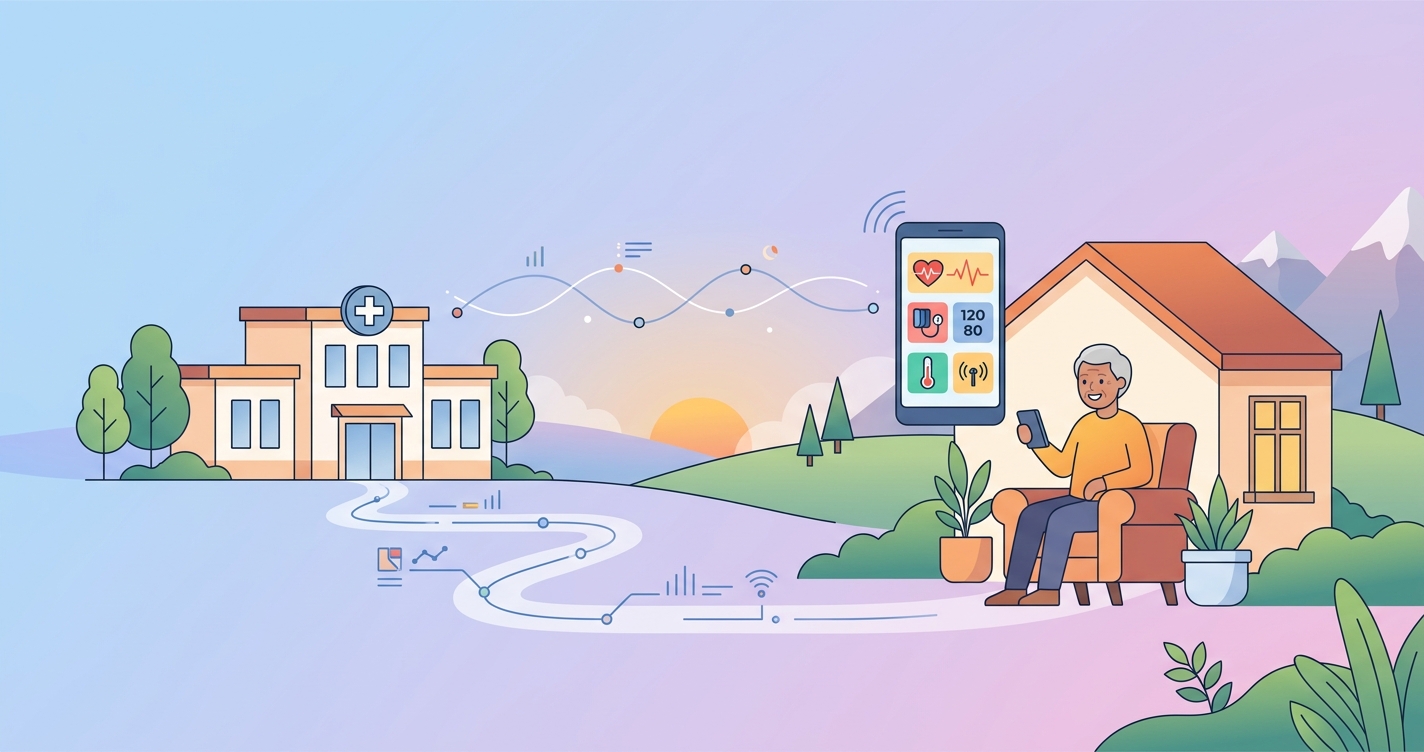
Rural hospitals are being asked to do more with less. They cover larger geographies, manage thinner staffing, and serve patient populations that often travel farther for routine follow-up than urban systems would tolerate for a specialist visit. That is why rural hospitals RPM extend reach has become more than a search phrase. It describes a real operating shift. Remote patient monitoring is giving rural organizations a way to stretch scarce clinical capacity, keep more follow-up local, and build care models that do not depend on every patient returning to the facility for every vital-sign check.
"Telehealth interventions in rural communities were associated with positive outcomes including improved access, lower travel burden, and high patient satisfaction." — Michael Butzner and Yendelela Cuffee, Journal of Medical Internet Research narrative review (2024)
Why rural hospitals RPM extend reach in practical terms
Rural hospitals do not usually need another abstract digital strategy. They need coverage. They need ways to follow discharged patients across long distances, keep chronic disease management moving between visits, and support front-line teams that cannot hire unlimited nurses, cardiologists, pulmonologists, or care coordinators.
Remote patient monitoring helps because it changes where observation happens. Instead of making the hospital the only place where recovery is visible, RPM allows symptoms, vital signs, and adherence signals to travel back to the care team from the home. That matters more in rural settings, where transportation is not a small inconvenience. It is often the reason follow-up fails.
A national study from a Yale-affiliated research team, published in Circulation: Cardiovascular Quality and Outcomes, found RPM availability at US hospitals rose from 33.0% in 2018 to 46.3% in 2022. Even so, rural hospitals still had substantially lower odds of offering RPM than urban hospitals. That gap is the story. Demand is there. Capacity is not evenly distributed.
Comparison table: how rural hospitals use RPM versus traditional follow-up
| Care dimension | Traditional rural follow-up model | RPM-enabled rural model |
|---|---|---|
| Travel requirement | Frequent trips back to clinic or hospital | More check-ins can happen from home |
| Staff visibility between visits | Limited | Ongoing symptom and vital-sign review |
| Access to specialty oversight | Constrained by geography and schedules | Easier to support hub-and-spoke review |
| Hospital-at-home potential | Harder to scale safely | More feasible with daily monitoring |
| Readmission prevention | Often reactive | Earlier intervention when trends worsen |
| Patient burden | Higher, especially for older adults | Lower when data capture is simple |
| Best use case | Patients near the facility | Large service areas and access gaps |
What rural hospitals are actually trying to solve with RPM
The biggest value of RPM in rural settings is not novelty. It is continuity.
Most rural organizations are using or evaluating RPM to address a familiar set of problems:
- keeping discharged patients visible during the first 30 days after hospitalization
- reducing avoidable transfers and readmissions
- supporting chronic disease management when specialty access is limited
- extending hospital-at-home or home-based acute care models
- helping nurses monitor larger populations without multiplying site visits
- preserving local care relationships instead of pushing every follow-up toward distant urban systems
That list sounds operational because it is. Rural hospitals often lose ground when care becomes logistically heavy. RPM works best when it removes friction rather than adds another device stack that patients ignore after week two.
Industry applications
Post-discharge recovery in wide service areas
For a rural hospital, discharge is often the start of uncertainty. A patient may live an hour away, have limited transportation, and struggle to return quickly if symptoms worsen. RPM gives teams a way to monitor blood pressure, pulse, oxygen saturation, weight, symptoms, or camera-based check-ins during that vulnerable period. The clinical value is simple: deterioration is easier to spot when someone is looking before the next scheduled appointment.
Chronic disease management with fewer local specialists
Rural hospitals commonly manage patients with heart failure, COPD, diabetes, and hypertension despite specialist shortages. RPM can support a local primary care or hospitalist-led workflow by making day-to-day trends visible. It does not eliminate the need for specialists, but it helps rural teams use specialist time more selectively.
Rural hospital-at-home models
One of the more interesting developments is the use of home-hospital pathways in rural areas. In a 2024 Annals of Internal Medicine article, Kevin J. Volpp and David M. Levine argued that home hospital programs could be especially valuable in rural settings because they can expand access while avoiding unnecessary facility-based utilization. The logic is strong: if hospital-level oversight can travel, the physical hospital no longer has to carry every episode alone.
That case became more concrete in a randomized clinical trial led by David M. Levine and Stuart R. Lipsitz on hospital-level care at home for adults living in rural settings. The trial reported similar costs and 30-day readmission rates compared with brick-and-mortar hospitalization, while patients in the home-hospital group showed higher activity levels and a better care experience. That does not mean every rural admission belongs at home. It does mean remote monitoring can support a credible rural alternative for selected patients.
Local reach for underserved populations
Rural access issues are often layered with income, broadband, and language barriers. Researchers at the University of Arkansas for Medical Sciences have pointed out that RPM can help reach Arkansans living in rural areas, but only if programs account for technology literacy, trust, and connectivity barriers. That is an important correction. RPM is not automatically equitable just because it is remote. Rural hospitals still need workflows that match the reality of the population.
Current research and evidence
The evidence base around rural telehealth is broader than RPM alone, but it is still useful. In their 2024 narrative review, Michael Butzner and Yendelela Cuffee found that telehealth interventions across rural US communities generally improved access, reduced travel costs, and produced strong patient satisfaction signals. That is not a narrow RPM trial, but it explains why remote follow-up models continue to gain traction in rural delivery systems.
The hospital availability data is also telling. The Yale-affiliated national RPM availability study found that adoption grew quickly between 2018 and 2022, yet rural hospitals remained less likely to offer RPM. Larger hospitals and teaching hospitals were more likely to have programs in place. In plain English, the hospitals that may need reach-extension tools the most have often had the hardest time standing them up.
There are also direct implementation signals. A UAMS-led study discussed barriers and interest in RPM among Arkansas residents, highlighting familiar issues: device comfort, Wi-Fi reliability, language access, and concern about how health data is used. I keep coming back to that point because it is easy to oversimplify rural digital health. The problem is not just distance. It is whether the program fits the household.
For executives, three conclusions stand out:
- rural RPM is strongest when it supports existing care relationships rather than replacing them
- low-friction workflows matter more than feature depth
- the return is often operational first: better follow-up, better visibility, better use of scarce staff time
Where program design matters most
Rural hospitals do not benefit from copying an academic medical center playbook line for line. Their RPM models usually work better when they are narrow, targeted, and realistic about staffing.
Programs tend to perform better when they:
- focus on a few high-risk pathways instead of trying to monitor everyone at once
- define who reviews incoming data and what triggers escalation
- use simple patient tasks that can survive weak connectivity and low tech confidence
- combine local care teams with virtual specialty backup when needed
- choose monitoring methods that reduce device logistics instead of increasing them
That last point matters for a site like trycarescan. Rural teams do not need more boxes to ship if the workflow can be simplified. Camera-based RPM and other software-first approaches are getting attention because they may reduce the compliance and logistics burden that has slowed some device-heavy programs.
The future of rural hospital reach extension
The future is probably not one giant rural RPM category. It is a set of specific use cases: post-discharge monitoring, hospital-at-home support, chronic disease surveillance, virtual nursing, and low-friction follow-up for patients who would otherwise fall out of care.
That is a better way to think about scale. Rural hospitals are not trying to digitize everything at once. They are trying to protect access in places where every missed follow-up has a cost.
Over time, the winning models will likely be the ones that ask less of patients and give more clarity to care teams. That could include lighter device kits, passive monitoring, and camera-based workflows that let a patient complete a check-in from a phone instead of managing another peripheral. The technology matters, but the operating model matters more.
Frequently asked questions
How do rural hospitals use RPM to extend their reach?
They use RPM to monitor patients at home, support post-discharge recovery, manage chronic disease between visits, and make specialist oversight easier across large geographic areas.
Why is RPM especially relevant for rural hospitals?
Rural hospitals deal with transportation barriers, staffing shortages, and wide service areas. RPM helps them keep patients visible without requiring every follow-up to happen in person.
Does RPM help rural hospital-at-home programs?
Yes. Remote monitoring is one of the core tools that makes rural hospital-at-home models workable for selected patients because it gives clinicians regular visibility into the patient’s condition outside the facility.
What limits RPM adoption in rural settings?
Common barriers include broadband gaps, staffing constraints, patient comfort with technology, language access, and the cost of deploying and supporting monitoring programs.
For rural hospitals, RPM is really about extending clinical presence without extending the building. Solutions like Circadify fit into that broader shift toward lower-friction remote monitoring that can help health systems keep care local. For related reading, see RPM for Cardiac Rehabilitation: How Remote Monitoring Helps and The Science Behind Camera-Based Heart Rate Measurement.