How Skilled Nursing Facilities Use Remote Monitoring Technology
Research-based analysis of how skilled nursing facilities use remote monitoring technology to catch decline earlier, support staff workflows, and reduce avoidable transfers.
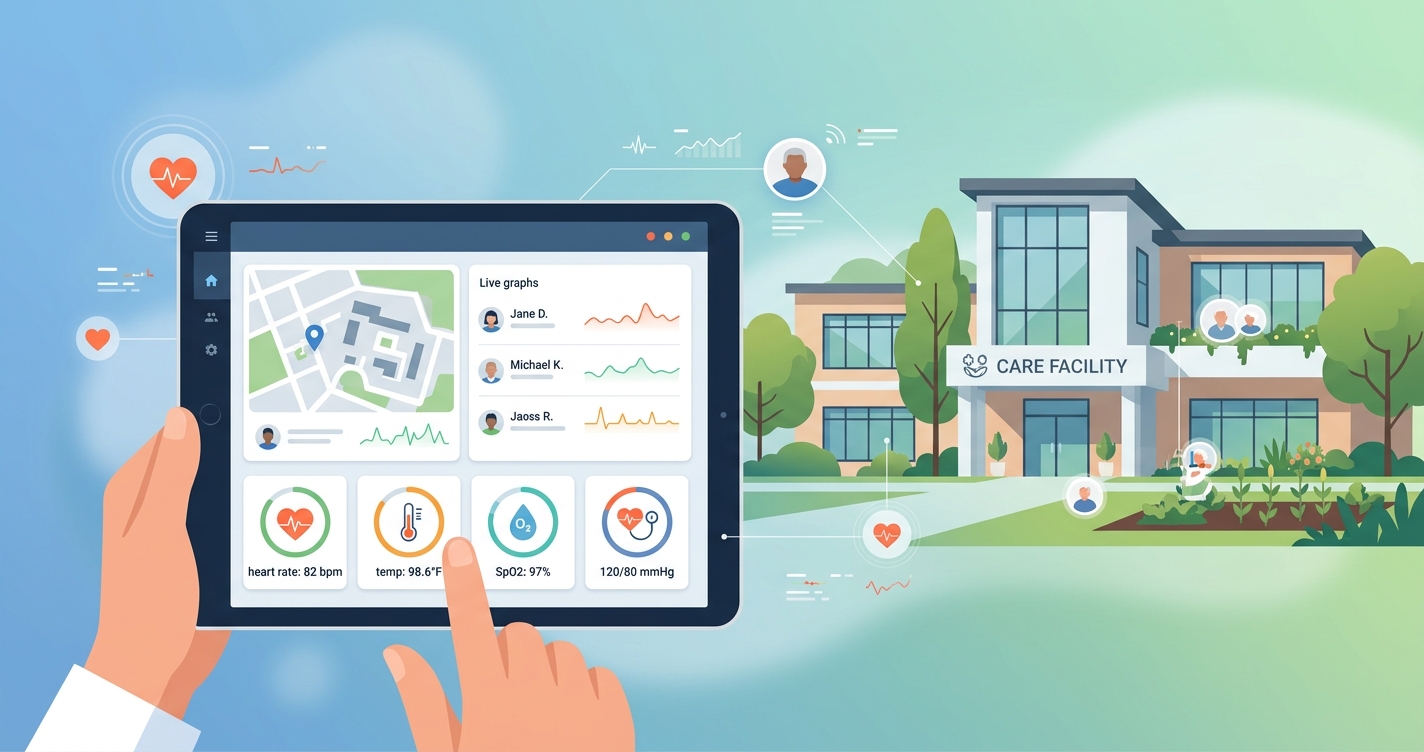
Skilled nursing facility remote monitoring has become less of a futuristic idea and more of a workflow question. SNFs already manage residents who are clinically fragile, recently discharged, and at real risk of deterioration between physician visits. The practical appeal of remote monitoring is simple: catch problems sooner, standardize escalation, and give nurses more timely visibility into changes that might otherwise show up only after a fall, a transfer, or an avoidable readmission. In a skilled nursing setting, that makes remote monitoring less about gadgets and more about surveillance that fits the pace of post-acute care.
"The intervention included training and technical assistance to establish or enhance quality-improvement infrastructure and implement INTERACT tools in skilled nursing facilities." — T. P. Meehan Sr. and colleagues, Journal of the American Medical Directors Association (2015)
Why skilled nursing facility remote monitoring is getting more attention
SNFs sit in a difficult middle zone. Residents are usually not acute enough for a hospital bed, but they are often too unstable for a low-touch follow-up model. That creates a constant operational tension: how do staff recognize subtle decline early enough to act before a transfer becomes unavoidable?
Remote monitoring technology helps because it adds more structure to that surveillance layer. The technology can include connected blood pressure cuffs, pulse oximeters, thermometers, weight scales, symptom check-ins, and, in some models, camera-based assessments completed on a phone or tablet. The point is not continuous ICU-style monitoring. It is earlier recognition.
That distinction matters. A lot of SNF care is about pattern detection:
- a resident who is eating less than usual
- blood pressure drifting after a medication change
- oxygen saturation falling before respiratory distress is obvious
- heart rate or temperature shifting before a nurse would normally call a provider
- recovery after discharge not progressing the way the care plan assumed
The AHRQ INTERACT program has leaned into this logic for years. Its Stop and Watch early warning tool was built around helping front-line staff identify condition changes sooner and communicate them clearly. Remote monitoring fits that same operating philosophy, just with more structured data feeding the process.
Comparison table: how SNFs use remote monitoring technology
| Use case | Traditional SNF workflow | Remote monitoring workflow |
|---|---|---|
| Post-hospital admission | Periodic vitals and staff observation | Scheduled vitals plus connected trend review |
| Change in condition | Escalation after symptoms become obvious | Earlier review when vitals or symptoms drift |
| Chronic disease follow-up | Snapshot checks around med pass or visits | Repeated readings over days to spot direction of change |
| Night and weekend coverage | Heavier reliance on phone updates and judgment | More objective trend data for on-call decisions |
| Hospital transfer prevention | Often reactive | More chances for early intervention |
| Staffing model | High dependence on manual rounding | Manual rounding plus software-supported review |
What skilled nursing facilities are actually monitoring
The most realistic skilled nursing facility remote monitoring programs are usually narrow rather than broad. They focus on a few scenarios where earlier detection changes care.
Post-acute recovery after hospital discharge
This is probably the clearest fit. A resident arrives from the hospital after surgery, heart failure treatment, pneumonia, COPD exacerbation, or another acute episode. The first days matter. Staff want to know whether the resident is stabilizing, decompensating, or drifting into a readmission pathway.
Remote monitoring is useful here because it gives more than one data point. Instead of a single reading during a shift, staff can review a short run of measurements and symptoms. That is often enough to separate normal recovery from something that needs a clinician call.
Chronic disease surveillance
SNFs also use monitoring to manage residents with hypertension, heart failure, diabetes, COPD, and other conditions that can worsen slowly. The value is not that every resident needs an advanced device stack. Most do not. The value is that some residents benefit from more frequent signals without requiring a provider visit every time.
Margaret M. Paul and colleagues wrote in JMIR in 2025 that remote patient monitoring for chronic disease management in the United States remains uneven, with wide variation in implementation, reimbursement, and workflow maturity. That broader national pattern shows up in SNFs too. The organizations getting value are usually the ones pairing monitoring with a clear review process, not just buying hardware.
Transitional care and readmission reduction
Readmission pressure is a permanent part of post-acute operations. CMS keeps readmission performance in view through the Skilled Nursing Facility Value-Based Purchasing program, which is one reason early detection matters so much operationally. If a facility can identify decline before it becomes an emergency transfer, that helps residents and protects the business side of post-acute care.
This is where remote monitoring becomes attractive to administrators. It can support more disciplined escalation by giving the team a cleaner answer to basic questions: Has the resident been stable for three days? Did oxygen saturation fall gradually or all at once? Is blood pressure recovering after a medication adjustment, or not?
Industry applications
Respiratory surveillance
Respiratory decline is one of the most obvious use cases. Connected pulse oximetry, temperature checks, symptom reporting, and repeated respiratory observations can help staff identify worsening illness sooner, especially in residents with COPD, pneumonia risk, or recent respiratory admissions.
Cardiac and fluid-status monitoring
Residents with heart failure or cardiovascular disease often move gradually before they crash. Weight, pulse, blood pressure, oxygen saturation, and symptom trends can support earlier medication review or physician outreach.
Medication-change observation
SNFs frequently titrate or adjust medications after discharge. Monitoring can make those transitions safer by helping nurses and prescribing clinicians see whether the resident is tolerating the change.
Higher-acuity step-down care
Some facilities are trying to care for residents who would previously have stayed longer in the hospital. That pushes SNFs toward a more data-rich workflow. Not hospital-level telemetry, obviously, but more structured observation than a traditional long-term care model.
Current research and evidence
The evidence base is still mixed, but several sources point in the same direction: technology works best when it strengthens workflow, communication, and escalation.
T. P. Meehan Sr., D. J. Qazi, T. J. Van Hoof, and colleagues published a JAMDA process evaluation in 2015 on a quality-improvement project designed to reduce hospital readmissions from skilled nursing facilities. The intervention was not a pure RPM trial, but it is still highly relevant because it focused on building infrastructure, staff training, and standardized tools such as INTERACT. That is a useful reminder that better outcomes in SNFs rarely come from technology alone.
Agne Ulyte, Ateev Mehrotra, Andrew D. Wilcock, Gillian K. SteelFisher, David C. Grabowski, and Michael L. Barnett reported in JAMA Network Open in 2023 that telemedicine visits became a meaningful part of care delivery in US skilled nursing facilities during the pandemic period. Telemedicine is not the same thing as remote monitoring, but the study matters because it showed SNFs are willing to adopt technology when it fits staffing and physician-access constraints.
The AHRQ-backed INTERACT framework points to the same operational truth. Early warning tools work when nursing assistants, nurses, and clinicians share a common escalation language. Remote monitoring technology is most helpful when it drops into that structure instead of creating a parallel workflow nobody owns.
Margaret M. Paul and colleagues added a broader RPM perspective in their 2025 JMIR review of chronic disease management in the United States. Their work suggests the market is still fragmented, but it also makes clear that RPM has moved out of the pilot-only phase. For SNFs, that probably means the question is no longer whether monitoring belongs in post-acute care. The real question is which residents, which signals, and which staffing model justify it.
Where skilled nursing facility remote monitoring programs usually succeed or fail
This is the part people tend to understate. In SNFs, remote monitoring succeeds when it makes the clinical team calmer and faster. It fails when it creates another dashboard that staff ignore.
Programs are usually stronger when they:
- focus on specific resident groups rather than the entire census
- define who reviews incoming data and how often
- connect alerts to a standing escalation pathway
- use simple equipment or low-friction software workflows
- train CNAs, nurses, and providers on the same communication model
- measure avoided transfers, response time, and workflow adherence instead of device counts
I keep coming back to that last point. Facilities do not need more devices for the sake of saying they are digital. They need earlier decisions.
The future of remote monitoring technology in skilled nursing facilities
The next phase will probably look less like a gadget rollout and more like selective, software-supported observation. Some SNFs will keep using connected peripherals. Others will move toward lighter, camera-based, or app-based check-ins where the clinical pathway allows it. Either way, the direction seems pretty clear: administrators want tools that reduce blind spots without adding a lot of logistics.
That matters in a sector dealing with tighter staffing, sicker residents, and more pressure to manage readmission risk. The winning model is unlikely to be the one with the most sensors. It will be the one that helps nurses decide faster, document more clearly, and escalate earlier.
Frequently Asked Questions
How do skilled nursing facilities use remote monitoring technology?
Most SNFs use remote monitoring technology to track vital signs, symptoms, and recovery trends for residents who are at higher risk of deterioration after hospital discharge or during chronic disease management.
What conditions are most commonly monitored in SNFs?
Common targets include heart failure, hypertension, COPD, post-surgical recovery, respiratory illness, and other situations where repeated vital-sign checks can help staff catch decline earlier.
Does remote monitoring replace nursing judgment in skilled nursing facilities?
No. It works best as an added surveillance layer that supports nursing judgment, documentation, and escalation rather than replacing bedside assessment.
Why is remote monitoring attractive to SNF operators?
Because it can help standardize follow-up, support readmission reduction efforts, and give staff more objective trend data when deciding whether to escalate care.
Skilled nursing facilities use remote monitoring technology because post-acute care has become more compressed and less forgiving. Residents arrive sicker, staff have less margin for missed change, and avoidable transfers are expensive. Solutions like Circadify fit into that broader move toward lower-friction monitoring for care teams that need earlier signals without turning every resident into a device logistics project. For related reading, see The Clinical Workflow for Camera-Based Remote Patient Monitoring and How RPM Reduces Emergency Department Overcrowding.