How RPM Reduces Emergency Department Overcrowding
Research-based analysis of how RPM reduces emergency department overcrowding by catching deterioration earlier and shifting more acute care follow-up home.
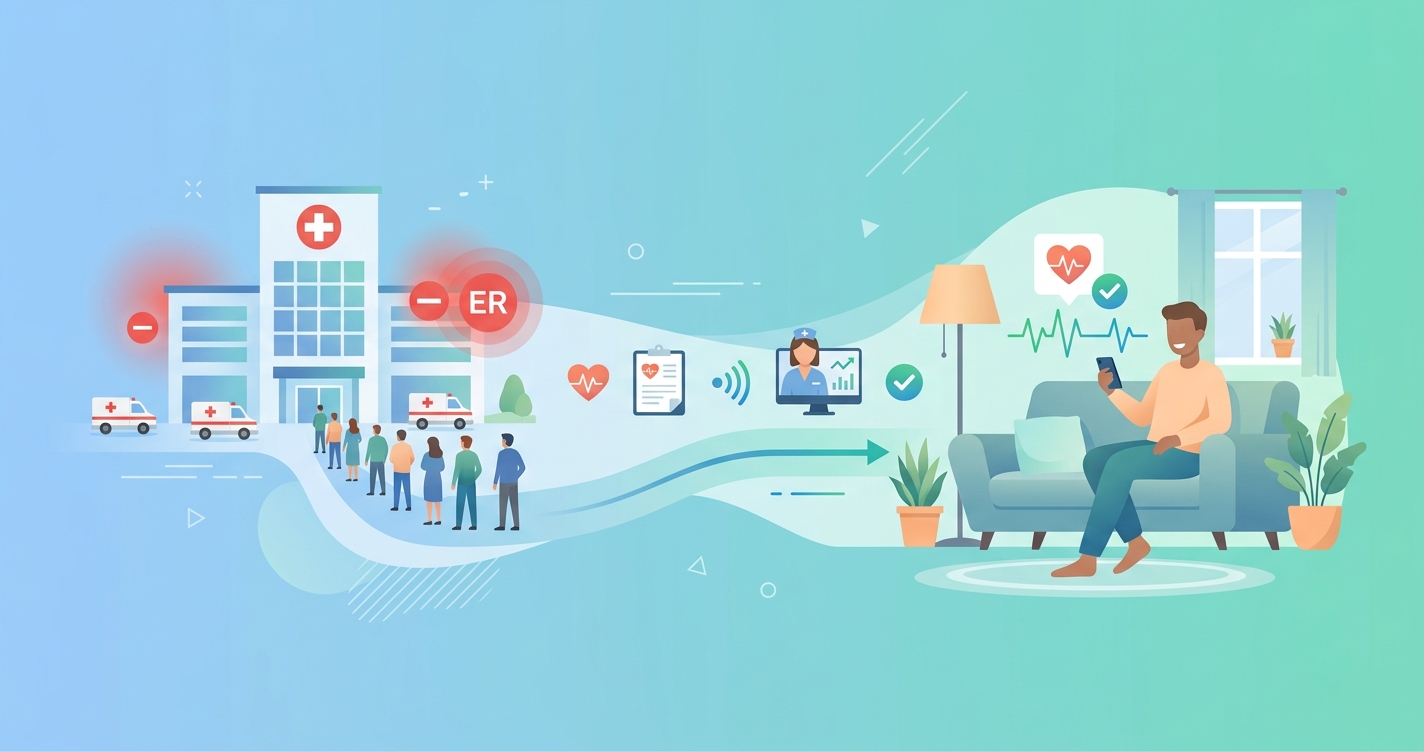
RPM reduce emergency department overcrowding is awkward as a keyword phrase, but the underlying question is real. Health systems are looking for ways to keep emergency departments from absorbing problems that could have been handled earlier, somewhere else, with better visibility. Remote patient monitoring sits right in that gap. It gives clinicians another chance to catch worsening symptoms before a patient rebounds to the ED, and it gives hospitals a way to manage certain post-discharge and hospital-at-home pathways without turning the emergency department into the default safety net.
"Home hospital care had 38% lower adjusted mean cost, lower laboratory use, lower imaging use, fewer consultations, and higher physical activity." — David M. Levine and colleagues, randomized controlled trial in Annals of Internal Medicine (2020)
Why RPM reduces emergency department overcrowding in the first place
Emergency department crowding usually gets framed as a front-door problem. Too many arrivals. Too few beds. Not enough staff. That is true, but it is only part of the story. A crowded ED is often the downstream result of weak follow-up after discharge, poor visibility into high-risk patients at home, and a lack of practical alternatives for patients who worsen between scheduled visits.
That is where RPM matters. Instead of waiting for a patient to feel bad enough to return to the hospital, teams can review symptoms, vital signs, and trend changes sooner. Eric W. Maurer, Terrence Adam, Lynn E. Eberly, Ahmed Alsharit, Stephanie Billecke, Tucker Annis, Sameer Badlani, Susan Pleasants, and Genevieve B. Melton studied a post-ED-discharge RPM program across 10 hospitals and found that activated patients had a 16.2% lower hazard of returning to the ED over the following year. That is not a magic fix for crowding, but it is exactly the kind of reduction systems care about when avoidable return visits are piling up.
The bigger point is operational. ED crowding gets worse when every unstable-looking patient has only one obvious escalation path. RPM creates more options: nurse outreach, medication review, same-day clinic follow-up, virtual reassessment, or targeted escalation into hospital-at-home workflows rather than automatic ED re-entry.
Comparison table: how RPM changes pressure on the emergency department
| Pressure point | Traditional approach | RPM-enabled approach |
|---|---|---|
| Post-discharge visibility | Limited until the next appointment or return visit | Daily or scheduled home check-ins create earlier visibility |
| Early deterioration | Often discovered after symptoms become severe | Clinicians can review trends before the patient reaches crisis |
| Low-acuity rebound visits | Common when patients are unsure what to do | Triage teams can redirect some patients to virtual or outpatient follow-up |
| Bed demand | ED becomes a holding area for unresolved risk | More patients can be managed upstream or at home |
| Staffing focus | Staff spend time on preventable revisits | Staff can focus more on patients who truly need emergency care |
| Hospital-at-home support | Harder to run safely without monitoring | RPM creates the oversight layer home-based acute care needs |
What kinds of overcrowding problems RPM can actually solve
It helps to be specific. RPM is not a universal answer to boarding, inpatient bed shortages, or trauma surges. It works best on the parts of ED congestion that come from poor continuity rather than pure capacity shock.
A good RPM program can reduce pressure in a few predictable ways:
- by lowering avoidable ED revisits after discharge
- by catching deterioration earlier in high-risk chronic disease populations
- by supporting home-based acute care for selected patients
- by giving triage teams more confidence to manage lower-acuity follow-up outside the ED
- by making post-discharge outreach more systematic instead of purely reactive
I keep coming back to that last point. Many overcrowding discussions drift toward architecture, staffing ratios, or ambulance queues. Those issues matter. But some crowding is simply the visible result of patients boomeranging back into acute care because nobody had a usable way to watch them at home.
Industry applications
Post-ED discharge monitoring
This is the clearest use case. Patients leave the ED with instructions, maybe a medication change, and a short period of elevated risk. Maurer and colleagues showed that an RPM layer after ED discharge can reduce the chance of a return visit. In operational terms, that means the emergency department is not forced to re-evaluate as many patients whose decline could have been recognized and managed sooner.
Hospital-at-home pathways
David M. Levine, Kei Ouchi, Bonnie Blanchfield, Agustina Saenz, Kimberly Burke, Mary Paz, Keren Diamond, Charles T. Pu, and Jeffrey L. Schnipper tested hospital-level care at home in a randomized controlled trial. Their work is useful here because ED crowding and inpatient crowding are linked systems. When hospitals can safely move selected acute care episodes into the home with monitoring, they free facility capacity and lower the number of patients moving back through emergency channels.
This is one reason hospital-at-home programs keep showing up in overcrowding conversations. They do not erase emergency demand, but they can ease the back-end congestion that causes ED beds to stay occupied longer than they should.
Chronic disease management for frequent utilizers
Older adults with multiple chronic conditions account for a disproportionate share of urgent utilization. In a multicenter JMIR study of a home-based RPM system for polypathological older adults, investigators reported a 48% decrease in hospitalization and ED visit rates and a 63% decrease in total hospital-stay duration. Those are unusually strong numbers, and they come from a high-risk population that often drives recurrent ED demand.
This kind of result matters because the overcrowding problem is not evenly distributed. A relatively small set of medically complex patients can generate a large share of repeat acute care use. When RPM works in that segment, the effect on operations can be larger than the raw enrollment count suggests.
Virtual observation and nurse-led triage
RPM also helps health systems build a middle layer between "everything is fine" and "go to the ED now." That middle layer may be a centralized nursing team, a virtual command center, or a disease-specific monitoring pathway. The exact model varies. What matters is that the patient has another route into care before the emergency department becomes the only option left.
Current research and evidence
The evidence base is not all pointing to one single RPM model, and that is worth admitting. Different programs use different devices, patient populations, staffing patterns, and escalation rules. Still, the direction is pretty consistent.
Maurer and colleagues provide a strong signal on ED discharge. Their 10-hospital study found fewer later ED returns among activated RPM patients, which makes the case that monitoring does more than generate data; it can change utilization.
The JMIR multicenter study on older adults with polypathology adds another angle. Its reported reductions in hospitalizations, ED visits, and hospital-stay duration suggest that home monitoring can take pressure off acute care when programs focus on patients with high baseline risk.
Levine and colleagues add the system-level argument. Their randomized home-hospital trial showed lower adjusted costs and less resource use while maintaining hospital-level care in the home. That matters for emergency departments because overcrowding is often inseparable from the inability to move patients efficiently across the rest of the system.
AHRQ's PSNet summary on remote patient monitoring lands in a similar place from a safety and workflow perspective: RPM is most useful when it is tied to clear triage, escalation, and communication rather than deployed as passive data collection. I think that is the right way to read the literature. Monitoring does not reduce overcrowding on its own. Monitoring tied to action does.
Where health systems get this wrong
Some RPM programs fail because they are built like technology pilots instead of care pathways.
Common mistakes include:
- enrolling patients without defining who reviews incoming data
- creating alert volume without response protocols
- treating RPM as a gadget program instead of a triage workflow
- choosing patient populations too broad to manage well
- measuring device distribution instead of avoided utilization
That last metric can be deceptive. A program can ship hundreds of kits and still do almost nothing for overcrowding if it does not change how nurses, physicians, and care managers intervene between visits.
The future of RPM and emergency department flow
The future probably belongs to narrower, more targeted RPM deployments rather than giant one-size-fits-all rollouts. Health systems are getting better at asking which pathways most reliably send patients back to the ED and which of those pathways could be watched from home with a realistic staffing model.
I would expect the strongest growth in three areas: post-discharge surveillance, hospital-at-home expansion, and lower-friction monitoring methods that do not depend on shipping hardware to every patient. That is where camera-based RPM becomes interesting for operators. If a patient can complete a brief check-in from a phone instead of juggling another stack of peripherals, adherence may improve and workflow friction may fall.
Emergency department overcrowding is not going away. But the systems that handle it best will probably be the ones that stop thinking of the ED as the first place where deterioration becomes visible.
Frequently asked questions
How does RPM reduce emergency department overcrowding?
RPM reduces overcrowding by helping clinicians detect worsening conditions earlier, manage some patients from home, and lower avoidable return visits after discharge.
Does RPM eliminate emergency department crowding?
No. It does not solve every cause of crowding, especially inpatient boarding or staffing shortages. It is most effective on preventable revisits and conditions that can be monitored safely at home.
Which patients benefit most from RPM in this context?
High-risk post-discharge patients, people with multiple chronic conditions, and patients enrolled in hospital-at-home or virtual care pathways often offer the clearest opportunity to reduce avoidable ED use.
Why is hospital-at-home relevant to ED overcrowding?
Hospital-at-home programs use remote monitoring and home-based clinical care to treat selected acute patients outside the hospital, which can ease pressure on beds and improve flow across the whole system.
For health systems trying to reduce emergency department overcrowding, the real value of RPM is not novelty. It is earlier visibility and more usable options between home and the ED. Solutions like Circadify fit into that broader move toward lower-friction remote monitoring. For related reading, see How Rural Hospitals Use RPM to Extend Their Reach and The Clinical Workflow for Camera-Based Remote Patient Monitoring.