How Federally Qualified Health Centers Use RPM for Underserved Populations
Research-based analysis of how FQHC remote patient monitoring supports underserved populations through lower-friction chronic care, outreach, and continuity.
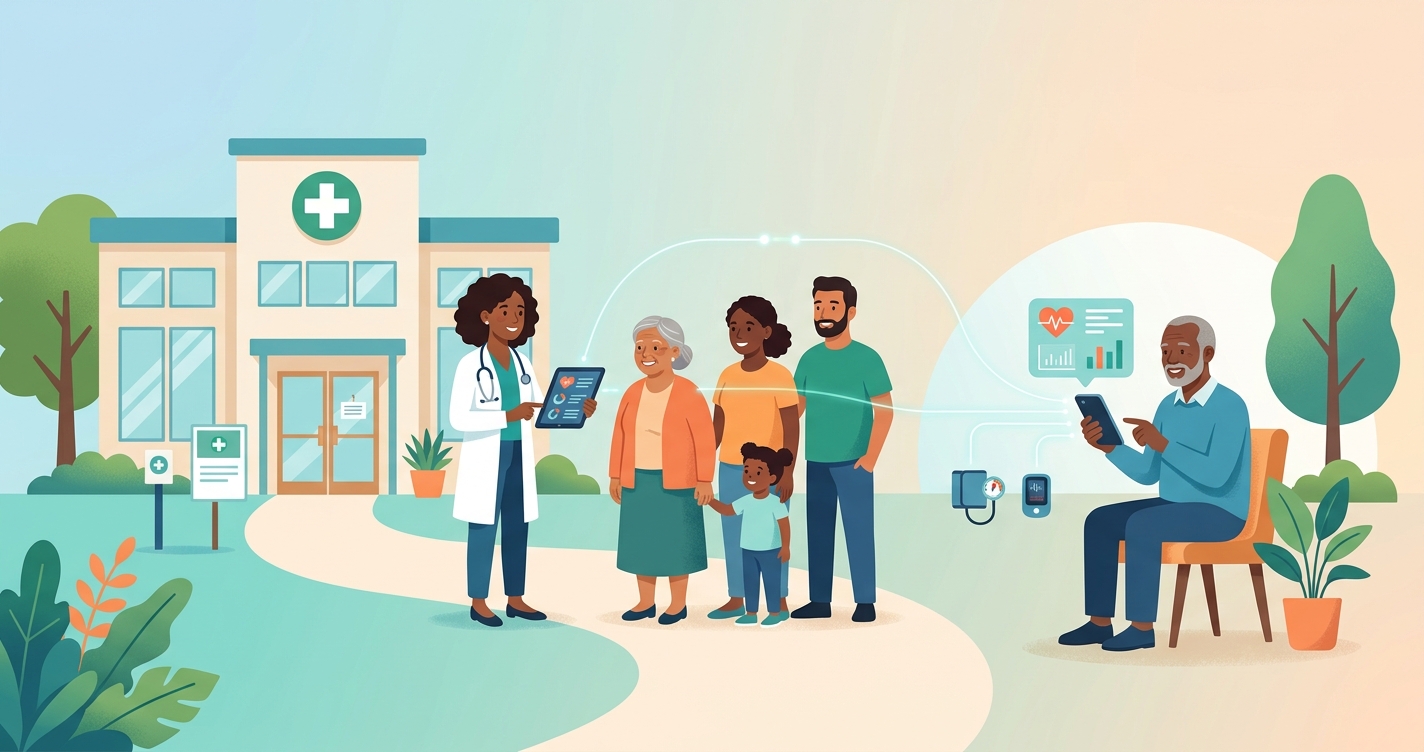
FQHC remote patient monitoring underserved populations is no longer a niche policy topic. It is becoming a practical operating model for safety-net providers that need to manage hypertension, diabetes, maternal health, and post-discharge risk without asking patients to make more in-person trips they may not be able to complete. For federally qualified health centers, RPM is useful when it extends care between visits, reduces missed follow-up, and fits the realities of patients dealing with transportation barriers, broadband gaps, unstable work schedules, and limited device access.
“Participants found RPM for SMBP acceptable and easy to use.” — study of Texas FQHC patients published in BMC Health Services Research (2025)
Why FQHC remote patient monitoring underserved populations has moved from pilot idea to delivery strategy
Federally qualified health centers sit at the center of the U.S. safety net. HRSA reports that health centers served more than 32.4 million people in 2024, with about 90% of patients at or below 200% of the federal poverty level. That scale matters because it explains why RPM in FQHC settings is not really about gadget adoption. It is about whether a care model can stay connected to patients who are statistically more likely to face affordability, transportation, and access barriers.
The policy environment has also shifted. CMS expanded the HCPCS G0511 general care-management code in 2024 so FQHCs and Rural Health Clinics can bill for remote patient monitoring and remote therapeutic monitoring. That change did not solve every sustainability problem, but it did move RPM closer to being an operationally supportable service line instead of a grant-only experiment.
In other words, the question has changed. It is no longer whether underserved populations could benefit from more continuous monitoring. The real question is how FQHCs are designing RPM so it works in a safety-net context.
Comparison table: how FQHC RPM differs from traditional follow-up for underserved populations
| Care dimension | Traditional follow-up model | FQHC RPM-enabled model |
|---|---|---|
| Blood pressure or symptom checks | Dependent on return visits | Ongoing monitoring between visits |
| Transportation burden | High for many patients | Lower when data is captured from home |
| Visibility between appointments | Limited | Better trend visibility for care teams |
| Staff response model | Often visit-based and reactive | More proactive outreach and escalation |
| Fit for uninsured or unstable patients | Gaps appear quickly after missed visits | Better continuity when workflows are simple |
| Equity risk | Patients with fewer resources fall out of care faster | More opportunity to intervene before deterioration |
| Best use case | Stable patients with reliable access | Patients facing care-access friction |
What FQHCs are actually trying to solve with RPM
Safety-net clinics are usually not adopting RPM because it sounds innovative. They are adopting it because the standard visit cadence is often too thin for patients with chronic disease risk and too fragile for patients whose lives make routine follow-up hard.
Common FQHC goals include:
- improving hypertension control between visits
- maintaining visibility into high-risk diabetes and maternal-health populations
- reducing avoidable emergency department use and readmissions
- supporting outreach for patients who miss follow-up appointments
- giving care teams better data for medication titration and coaching
- extending clinical presence into homes without requiring additional travel
I keep coming back to self-measured blood pressure monitoring because it is such a practical use case. It addresses a high-burden chronic condition, creates data clinicians can actually act on, and fits team-based primary care better than a lot of flashier RPM concepts.
Industry applications
Hypertension management in community health centers
The strongest FQHC RPM evidence today centers on blood pressure monitoring. In a 2025 BMC Health Services Research study, researchers examined Texas FQHC patients using telehealth-supported remote patient monitoring for self-measured blood pressure. The sample was largely Hispanic/Latino and predominantly uninsured. Patients used RPM for an average of 46 days and 72 readings within the first 120 days, and the authors found that participants generally considered the system acceptable and easy to use.
That is important because patient acceptance is often the hidden make-or-break factor in underserved settings. A monitoring model can look strong on paper and still fail if the workflow is confusing, device-heavy, or easy to abandon.
Team-based chronic care workflows
A second useful signal comes from Ohio. Heather G. Zook, Rachel S. Cruz, Traci R. Capesius, and Melissa Chapman Haynes studied how FQHCs implemented self-measured blood pressure monitoring with clinical support across Ohio community health centers. Their qualitative study found that health centers could make these programs work, but success depended on team-based care, health IT capacity, funding for monitors and staff time, leadership support, and external implementation help.
That may sound obvious, but it is the part people tend to underestimate. In FQHCs, RPM is not really a device project. It is a workflow project. The center has to decide who enrolls patients, who trains them, who reviews the data, and what happens when the readings start drifting in the wrong direction.
Health-equity use cases where visit friction is highest
FQHCs are often managing patients who work hourly jobs, lack reliable transportation, live in rural or semi-rural areas, or rotate phones and internet access. In that environment, RPM has the most value when it reduces friction rather than adding another hardware burden.
For underserved populations, the best RPM programs often emphasize:
- simple patient tasks that can be repeated at home
- cellular or low-friction data transfer when broadband is unreliable
- outreach workflows for patients who stop engaging
- language-access support and culturally competent onboarding
- escalation rules that connect readings to an actual care response
That is also why software-first and camera-based RPM models are getting more attention. When a clinic can remove some hardware logistics from the workflow, it reduces shipping, replacement, charging, and setup problems that disproportionately affect the very patients the program is supposed to help.
Maternal health, diabetes, and post-discharge monitoring
Hypertension is the clearest FQHC RPM use case, but it is not the only one. Safety-net organizations are also evaluating remote monitoring for maternal care, diabetes support, and post-discharge follow-up. The common thread is continuity. If a patient is unlikely to return easily for frequent in-person checks, remote monitoring gives the care team a chance to identify deterioration or nonadherence sooner.
Current research and evidence
The Texas FQHC patient-experience study is useful because it goes beyond simple adoption claims. It shows that underserved patients will use RPM when the program is understandable and relevant. The study population was 64% female, 89% Hispanic/Latino, and 75% uninsured, which makes it especially relevant to safety-net operations.
There is also outcome evidence pointing in the same direction. In an American Heart Association abstract, Craig Flanagan, Brett Colbert, Kevin Davis, and Wesley Smith of HealthSnap compared hypertension RPM results in FQHC and primary care settings. Both groups showed significant blood-pressure improvement, and the FQHC cohort reduced systolic blood pressure from 152.3 to 134.9 mmHg. For executives, the main takeaway is not that every RPM program will reproduce those numbers. It is that underserved populations in FQHC settings can engage with and benefit from structured remote monitoring when the workflow is actually supported.
The Ohio qualitative research adds a second layer of realism. Zook and colleagues found that implementation barriers were real: staffing shortages, technology challenges, low patient engagement in some cases, and sustainability concerns all showed up. That makes the evidence more credible, not less. FQHC RPM does not work because the barriers disappear. It works when clinics design around them.
Where program design matters most for underserved populations
Underserved populations are usually failed by complexity before they are failed by clinical logic. That is why FQHC RPM programs tend to work better when they are narrow, operationally clear, and light on patient burden.
The most durable models usually:
- start with a focused clinical pathway rather than a broad population promise
- match outreach staffing to enrollment volume
- choose monitoring methods that reduce, rather than multiply, device logistics
- define response thresholds clearly so patients know data will lead to action
- account for language, literacy, and connectivity realities from day one
That last point deserves emphasis. Health equity is not created just by offering RPM. It is created by designing RPM so patients with the fewest resources can still complete the workflow consistently.
The future of FQHC remote monitoring will be measured by friction reduction
I doubt the future of RPM in FQHCs will be decided by who has the most sensors. It will probably be decided by who can create the lowest-friction path to continuous care.
That likely means a mix of monitoring approaches. Some patients will still need traditional devices. Others may do better with simpler smartphone-based check-ins, cellular connectivity, or passive monitoring models that reduce training and support demands. As reimbursement becomes clearer and health centers get more implementation experience, the winning programs will probably be the ones that make remote monitoring feel less like an extra task and more like an extension of ordinary care.
For underserved populations, that is the real promise. RPM is not just a technology layer. It is a way to keep care from disappearing between appointments.
Frequently Asked Questions
How do federally qualified health centers use RPM for underserved populations?
They use RPM to monitor patients between visits, especially for hypertension and other chronic conditions, so care teams can intervene earlier without requiring as many in-person appointments.
Why is RPM relevant for FQHCs specifically?
FQHCs serve patients who often face transportation, affordability, broadband, and scheduling barriers. RPM helps extend clinical visibility into the home and can reduce care gaps caused by missed follow-up.
What conditions are most common in FQHC RPM programs?
Hypertension is the clearest current use case, but FQHCs are also evaluating RPM for diabetes, maternal health, and post-discharge monitoring where continuity is hard to maintain through office visits alone.
What makes RPM succeed in underserved populations?
Programs tend to work best when onboarding is simple, response workflows are clear, language and connectivity barriers are addressed, and the monitoring approach does not create excessive device burden.
For safety-net providers, the bigger story is not just remote monitoring. It is lower-friction continuity of care. Solutions like Circadify fit into that broader shift toward software-first RPM models that can make outreach and follow-up easier to scale. For related reading, see How Rural Hospitals Use RPM to Extend Their Reach and What Is Passive Patient Monitoring? No-Touch RPM Explained for Clinicians.